natural skincare

Showing posts with label natural skincare. Show all posts. The posts are listed in chronological order. Click the post title to read more.

Sunday, November 29, 2015 in , , , , , , , , ,

Great leaps and Gratitude - Blissoma Botanical Beauty is open


For 5 months my life has been a whirlwind of soapy water, paint, wood dust, stain, polyurethane, glue, nails, screws and everything construction-related as I renovated the space that now holds the Blissoma Botanical Beauty Boutique.  I took possession on July 1 and quite literally right away I dove in headfirst to the work that needed doing.  I barely came up for air.  I've worked from home for years, and the immersion at the new location was complete.  I basically came home only to eat dinner, shower, and sleep most days.  My family was informed that I was essentially unavailable, given apologies, and asked to be patient for a bit with the greater good in mind.

This week the store finally opened after construction delays galore and slogging through all manner of unexpected problems including a basement full of smoke (turns out decades-old electrical circuits don't love being messed with), and staff having personal emergencies that took us down by one member.  Nothing about the second half of 2015 has been easy.  Having completed our first week open for business I feel more like I can reflect properly and meditate on the gratitude I feel. 


In 10 years in business I've watched dozens of small businesses (especially retail) start up and then really struggle and often fail for a wide variety of reasons. I have even seen it happen to friends, and it has been a cautionary tale for me. The cost of renting and running any kind of space capable of retail is high and so is all the pressure that puts on the business. It's a very real "sink or swim" test and you have to be ready for that level of intensity. Some people get into retail without really knowing what it will be like. I did not. 


I got in full well knowing the commitment of time, energy and money it would require after seeing the process many times over with friends and acquaintances. All those factors were reasons that I stayed incubated in my residential space for as long as practically possible. It was only when we were literally bursting at the seams and could not even store the supplies we needed to process the orders we were getting that I was ready to make this leap for our production and sales needs.


Even with an existing sales base, reasonably reliable cash flow (for our size) and a talented staff the growth step we've taken is still a major risk. Everything I have done since around 6/1/15 (when the lease was signed) and through at least that time in 2016 is important. I have to be on my game at every moment, operate efficiently, and use my time and energy wisely. There is no room for serious errors. I can't afford to take my eyes and intention off my vision.


Even with the fact that I know for sure that we are offering products and services that people truly need one still has moments of dire doubt. It did my soul so much good to see so many friendly faces walk through our doors this week. Some were my dearest friends who have helped support me and talk me through moments of crisis, big and small. Some were people that I've never seen in person but have followed us online, and some were totally new clients that discovered us for the first time. All of these gave me so much hope and truly refilled my emotional tank, and their consciously spent financial resources will contribute towards our practical survival. Both of these things were necessary right now, and I feel extremely grateful and lucky for both.


Despite the fact that sales is a totally learned skill for me I have sold products in many environments. I spent years doing demos in natural foods stores, which in general was just painful for me and also not the greatest energetic interaction with clients (though that had nothing to do with what I put into it!). Even if you have something great to offer people you still have to offer it in the right way and at the right time. The recipient has to be ready or defenses go up and they will likely reject it.


Seeing products sell in another dear friend's natural beauty store several years ago was one of the key things that helped convince me that there was a better way to sell my type of product - better for me and for the client. It is so much more effective to give people the space they need to desire an interaction, and to willingly enter into it. Prioritizing service and education helps people choose for themselves rather than having something shoved at them. It was a beautiful thing seeing so many people thoroughly embrace clean self-care and health sustaining products this week through our gentle and respectful sales process.

 
People left our store feeling better about their appearance, more like the version of themselves they are delighted to present to the world, and like they knew what to do with what they purchased to positively impact their daily lives. I am truly honored to be instrumental in helping create that feeling for our clients. As much as I'm happy about seeing my business grow and flourish, this impact on people is the thing about which I feel best.


Many small businesses would not have had the blessing of such a solid first week of sales. I know this is partly good planning on my part, but it is also partly good fortune and the goodwill of our community. It gives us the chance to keep going and to do much more.


I am thankful to so many people for putting up with me through what has arguably been one of the most important and stressful 6 months of my life. It has not been an easy ride, and I wouldn't have made it through without each of the people that spent time and energy helping make it happen. I did a lot, but I'm more aware than ever of how much I need everyone around me to be the best version of me that I can be. To my family, my friends, and my clients I continue to owe my absolute best. I will continue to give it.


Blissoma Botanical Beauty is located at 2730 LaSalle Street, St. Louis, MO 63104 in historic Flower Row.  We are open 9 AM to 5 PM Monday through Friday and 10 AM to 6 PM Saturday currently.

Our skincare pros and makeup artists are available for consultations, color matching, and assistance creating your unique look with nontoxic, healthy beauty products every day.  Please come visit us! 


Wednesday, September 9, 2015 in , , , ,

The Ugly .01% Secret of Active Ingredients in Skincare


Unless you hold a chemistry degree shopping for skincare can be confusing.  Consumer labeling standards have at least helped to clarify what is actually in each mysterious bottle of lotion or potion.  You can always check the ingredients panel to try and discern if the sales pitch matches the pith of the product, but even this area is a place that manufacturers play games.  They know many shoppers will breeze past grand claims of transformation and head straight to see what active ingredients are included in the nitty gritty, detailed list.  Some legal standards apply, but there's still plenty of room to manipulate. 

The ingredients list can both reveal and conceal.  In many cases the ingredients list itself is a smokescreen, obscuring that most skincare products don't have optimal, effective concentrations of the ingredients they claim are in each bottle. 

The reality is when you buy most drugstore and even many department store skincare products what you're buying is mostly emulsifiers, solvents, and water even when trendy actives appear in the ingredients list. 

The skincare and cosmetics industry is largely powered by marketing. Most companies spend far more on their promotion, advertising, and the perfect sales pitch than they do on the actual ingredients in the product they are selling to you. They capitalize on vanity, fear, and the customers’ lack of knowledge about chemistry. They prey on the fact that many people will pay dearly and believe marketing pitches that sound more like fairy stories than like chemistry.  While I love a good fantasy tale I'm not looking for one in my facial products.  Stories of rare and exotic ingredients create fervor and a mystic quality to a cream or serum… Sadly the story is often all they are actually selling, as the product inside is but a pale shadow of what is advertised. 


One of the ugliest, dirtiest secrets of the skincare world is that mass market formulators are actually *taught* how to basically defraud customers in designing recipes. Experts teach how to use the minimum quantity of an herbal or "active" ingredient in a formulation just to be able to put that ingredient on the label for marketing purposes. That means that even though you may see "Coenzyme Q10" or a list of fancy extracts on the label the dilution is taken so far as to render them completely ineffective. In chemistry and biology it often takes an optimal concentration of a compound before any noticeable effect is achieved, so this deliberate limiting of actives strips all the benefits from products. Well, at least all the benefits to the client’s skin. 

The cost savings from putting in the minimum of actives means bigger profit margins for brand owners. Actives are often the most expensive part of a recipe and also the most desirable to clients because of their benefits. If a product appears to have valuable actives in it then it will command a higher price and likely sell better, especially if the active ingredient is trendy. The combination of higher retail price and lower production cost is a set of practical, profitable business assets that many company owners find it hard to ignore. When profits are more important than people many ugly decisions are made in the name of “beauty”. 

Sometimes the skincare entrepreneur doesn't even know the optimal concentrations of ingredients.  The prevalence of contract packaging firms means many beauty company owners are far removed from the actual design of their recipes.  It's really rare that the company owner is actually the chemist.  Generally a chemistry buff and a marketing brain don't exist simultaneously in the same skull.  The beauty entrepreneur may select a base emulsion and then instruct the contract manufacturer to add several botanicals or extracts because they know those ingredients are "hot", but they've never actually researched what concentrations will provide true benefits.  The disconnect in this situation is immense, and only serves to create further confusion for customers.

Here is actual advice given by a mass market cosmetics formulation "expert" from a skincare industry group, paraphrased by one of the chemists who partook in the lecture: 

"* since your customer doesn't distinguish whether there is any extract (expensive ingredients used only for claims) in the product or not, you can reduce its concentration to the lowest possible concentration, let's say 0.01%, just to mention it on the label but you don't need higher concentrations that would unnecessarily increase the costs of the product without any function 

** increase the solvent concentration and reduce the active ingredients concentration to reduce the costs: water concentration in water based products MINERAL OIL or PG in non-aqueous product" 

This is the reality of the majority of products available through mass market sales venues.  Promises are peddled and broken on a daily basis, with profits continuing to flow into the pockets of duplicitous companies.  

In addition filler ingredients are not "neutral" for many people.  Many will likely cause skin irritation for many customers, prompting the inflammation, acne, and other problems the item was purchased to fix.  Silicones often cause breakouts as they form a film over pores. Petroleum fillers and synthetic emulsifiers can confuse and clog skin, damaging its protective barrier and microbiome. And water? You can get that from the tap for free.

You deserve so much better.

That is why the staff of Blissoma gets up every single day to make potent, authentically plant-based skincare. We don't put in the minimum of active ingredients. We put in the maximum. Every single recipe is absolutely packed to a point where we can't even fit anymore extracts, healing oils, and vitamins in without the emulsion coming apart or actives not staying in solution. Our potency is why our products heal, brighten, firm, hydrate and truly rejuvenate skin. 


Our potency is egalitarian. We pack in the actives because we believe everyone deserves to feel and look their very best. Good skin nutrition is key to achieving that end. Nutrients yield results so we make sure that our products are like a gourmet, whole food, herbal supplement for your skin. We’re gorgeously genuine and radically respectful of our clients. We don’t tell slick stories. We just want you to have a real daily romance with powerful plants. 

 
In our new store opening Fall 2015 in St. Louis we’ll be able to proudly show people our uniquely concentrated herbs extracting in jars, the pure, nutritious seed oils awaiting blending, and all the other healing ingredients we keep on hand. Our production area will be available to view so clients can get an intimate peek at what we do each day to earn your trust. Blissoma’s “put in the maximum” philosophy will be on display every day. 


Don’t be sucked in by the .01% secret. You are more than a number, more than a profit margin to the team at Blissoma. Get into a real relationship with your skincare brand and make sure you’re getting the actives and the results you deserve.


Friday, March 27, 2015 in , , , , , , , , ,

Why Some Skin Types Should Stop Using Coconut Oil - the mixed results of this otherwise healthy oil


Coconut oil may not be right for your skin type - coconut oil causes breakouts, coconut oil makes my skin dry

Coconut oil has gained a big following in natural beauty circles in recent years.  This oil does have a significant list of benefits including the fact that it is readily available at many natural food stores, affordable, shelf stable, 100% natural and nontoxic, and not environmentally problematic.  Books such as The Coconut Oil Miracle tout its extensive health benefits as an immune system support, weight loss aid, digestion and nutrition absorption aid and many other traits.  A simple Amazon search pulls up over 10 guides to the benefits of coconut oil including one specifically dedicated to pets and another for oil pulling.  I've personally found it to be fantastic for cooking and the flavor of virgin coconut oil makes a delectable popcorn topping for a Saturday evening movie at home.  Combine it with a bit of truffle oil, salt, and onion powder and you've got a mouth party like you've never known before.  

With all those delightful qualities you might be surprised to hear me say that in skincare coconut oil gives extremely mixed results.  Coconut oil is used in a starring role for everything from a makeup remover to a general moisturizer, and is frequently one of the first natural oils people experiment with for home recipes and DIY beauty.   Unfortunately for very dry skin and acne prone skin the results of coconut oil often skew towards breakouts and increased dryness. 

This incredibly popular post has been updated and reposted on the Blissoma.com home website blog in two sections.  We have added fresh research that can help you figure out how to fix your skin if you think coconut oil may be causing you problems.

Post #1: Is Coconut Oil Causing Dry Skin?  What You Need to Know.

Post#2: Is Coconut Oil Good for Acne? Surprising Info on the Popular Skin Care Ingredient.

Thank you so much for all the amazing response we have gotten over the years on this post!  Because of your many comments and incredible feedback we knew it was worth the effort to edit and share it in a permanent spot on our home site.  We hope you enjoy reading it there.


Thursday, August 7, 2014 in , , , , , ,

3 healthy summer skincare tips from Blissoma's staff esthetician


Blissoma now has full time staff esthetician.  Her name is Lauren and we're delighted to have her on our team.  Lauren has worked with us in a part-time capacity since early 2013 and supported the brand at demos, sales events, and helping with blogger outreach over the last 18 months before beginning full time status.


Lauren will be responsible for helping to grow Blissoma's online presence through social media including instagram, blog and vlog content, interacting with beauty bloggers, producing skincare alongside Frank, and answering clients’questions about the Blissoma line to help them solve their beauty challenges.


A 2011 graduate of the Skin Institute, Lauren is a certified, licensed esthetician. She received a Bachelor of Science degree from Stephens College in May 2009. She is certified with Dermalogica, SkinCeuticals and Jane Iredale. She also completed a five-week mentorship program with 30-year skincare veteran, Margot Cottier.

Lauren has been on her own journey through natural health and skincare through diet modifications due to allergies.  She has seen improvements in her skin with reductions in dairy consumption and increased clean plant content.

For summer Lauren wanted to offer some timely tips for maintaining your skin health despite heat and sun.

Tip #1
"Take advantage of the plethora of fruits and vegetables in season during the summer months and eat as much fresh food as possible.  Cucumbers are one of my favorite foods.  They are filled with water for hydration and are cooling to the body.  Bonus - Cut off a couple of slices and place over your eyes while relaxing with a detoxifying clay masque.

I suggest stopping by the farmer's market to see what is in season.  Get as much of your produce from local, organic farmers as possible to ensure it is pesticide free and fresh from the field."


Tip #2
"Be sure to stay hydrated with plenty of water to keep skin hydrated as well.  My favorite summer concoction is adding mint, lemons and fruit such as berries or peaches (my favorites!) to a pitcher of water to enjoy later.  Let it sit overnight or for a few hours and enjoy the refreshing, flavorful beverage.

You can also freeze mint leaves, berries and other fruit into ice cubes to use in herbal teas and water.  They look beautiful and the added color makes your favorite healthy beverage that much more enticing.  This is a great way to make your beverages feel exciting to drink without adding sugar content, which is inflammatory for skin."

Tip #3
"One of my favorite summer skincare products are toners.  I love misting my face and decollete morning and night.  I switch between toners in our line and right now I'm enjoying the Intense Hydration Tonique.  I've also used it to set my makeup before heading out in the evenings when I need my makeup to last through the night."

We hope you'll enjoy getting to know Lauren. She has a wonderful way with client service and has so far been handling our skincare consultation requests with care and skill.  Email her at esthetician@blissoma.com with your questions about your skin and the products that will be right for you.


Thursday, June 5, 2014 in , , , , , , , , , , , , , , , , , ,

How dandelions benefit your health and skin for natural beauty

How to use Dandelions for health and beauty - harvest dandelion leaf and root for health

With spring invariably comes a flush of yellow in fields everywhere.  Despite poison and pulling and the tireless efforts of homeowners everywhere dandelions doggedly stick their little stalks and leaves up out of the ground.  They're persistent and able to survive in soils in which garden plants couldn't even make room for a root.  Along roadways, in vacant lots, and yes, in your grass, they thrive.  We see commercials for killing sprays and men standing proudly surveying their dandelion-free lawn.  Since homeownership became common in the 1950s the quality of you as a human being might likely be judged by how weed free you could get your lawn.

Yet the dandelions still thrive.  Today I'm here to proclaim loudly that instead of vilification this plant practically deserves its own holiday.  Yes, you heard me!  Dandelions are one of the most valuable plants in Chinese Medicine, appear in the Pharmacopeias of 4 European countries, and even pop up in the U.S. National Formulary.  These maligned little plants pack a lot of healing help into all their parts.  The roots, leaves, and blossoms of our dear Taraxacum officinale can all be used for food and natural beauty purposes.

Dandelions are one of those abundant resources that we've simply become blind to over time.  They have a fleshy taproot that can penetrate even tough soils.  Many permaculture farmers and gardeners know that dandelions are not just good for people, they're good for the soil and other plants too.  Their taproot goes deep into the earth to transfer nutrients from layers below to the shallow rooted plants that surround them.  The taproot also punctures and aerates the soil, creating a way for water to infiltrate down even through hard soils.  At a permaculture presentation I attended given by Mark Shepard he jokingly stated that there isn't a dandelion within 100 yards of his house on his farm because his family has foraged them all.  It's free, healing food - doesn't get much better than that!  Not to mention they're green and growing much earlier in the spring than most gardeners have crops ready.  That's because they've been out there dormant just waiting for the warmth of spring so they can burst to life.  While you're still waiting for even your cool season crops to get a foothold you can be munching on dandelions.

Health benefits of dandelion leaf and root.  Dandelions contain vitamins A, C, K, minerals, and flavanols

The nutrient concentration abilities of the dandelion make it one of the worlds best foods nutritionally.  That's why you might even see dandelion greens sold in your local organic market.  This always makes me chuckle a bit because this would be one of the easiest plants for people to grow and use and yet they are paying beaucoup bucks for it a premium stores.  If you live in a condo and have no soil to grow in you get a pass, but if you've got a yard then for heavens sakes stop applying herbicide and enjoy the health enhancing dandelions that will grow abundantly for you with absolutely no care and maintenance.  Ignore them and they'll be fine.  Water them and they'll flourish.

The prevalence of greens in the spring is something I've seen many raw and locavore food enthusiasts discuss.  Rhythmically it makes sense.  In the winter one generally is eating a lot of preserved, starchy, and heavy foods.  This would have especially been true in years past when we weren't shipping fresh foods in from South America in the winter.  This can make the body and metabolism sluggish over time.  Spring greens give the body a chance to detoxify, and dandelions are particularly adept at this particular function.  They have compounds proven to cleanse the liver, stimulate bile production, and pull heavy metals from the body.  They're very nutritionally dense as well, and an influx of vitamins is a huge boon to our bodies as we enter a very active, sunny season.

Vitamins and nutrients in Dandelions:
  • Beta-carotene - Dandelions is the plant kingdom's richest sources of Beta-carotene which is then transformed into Vitamin A in your body.
  • Iron - A serving of dandelion greens contains just as much iron as spinach
  • Vitamin K - Dandelions have 535% of your Rda of this fat soluble vitamin.  It contributes to good blood flow and healthy blood vessels and may help to reduce bruising.  
  • Vitamin C - Antioxidant and anti-aging
  • Minerals - Dandelions contain potassium, calcium, magnesium, and phosphorous.  The root is a particularly potent spot for mineral concentration.
  • Vitamin B6, Thiamin, Riboflavin
  • Protein - Dandelions are a surprisingly good source of protein, comparable
  • Tof-CFr - A glucose polymer found to act against cancer cells in mice.
  • Pectin - This forms ionic complexes with metal ions, making it a prime compound of use in detoxifying the body of heavy metals.
  • Coumestrol - An estrogen mimic that can help stimulate milk flow and balance hormones.
  • Apigenin and Luteolin - These are flavonoid glycosides that have diuretic, anti-spasmodic, anti-oxidant, and liver protectant properties.
  • Taraxasterol - This may contribute to liver and gall bladder health.

For more details on many of these and further list see this fantastic article on the Leaf Lady.

Find percentages of daily values in this nutritional breakdown of dandelion greens.

To harvest dandelion from a wild place or your yard make sure you know the area hasn't been sprayed.  If you're harvesting for leaves young plants will be the most tender and least bitter.  If you want the root then look for mature plants early in the spring.  They've stored nutrients in their root and that makes it a potent time to harvest.  The soil is also loose from frost and will make your digging or pulling easier.  If you have packed soil you'll need a trowel to dig in and loosen it before you lift.  Pull from the base so it doesn't break off at the leaves.

Once you've got your roots and leaves clean them up.  The roots should be chopped and dried in a dehydrator or on a pan or screen in a spot with good air circulation.  It may take 3 to 14 days for complete air drying.

If you want to make dandelion "coffee" which is roasted then you can dry and roast the root at the same time.  Place the well-chopped root on a pan in the oven at 250F.  Place the oven door ajar to let moisture escape if you have a lot of root on your pan.  A single layer is best and will roast most evenly.  Stir periodically to prevent burning and to keep everything roasted consistently.  The root will shrink considerably as it dries.  As it gets dry watch it most closely toward the end as it can burn fast once there is no moisture left in it.  The root will be a nice medium brown color when finished.

How to prepare dandelion leaf and root to use for dandelion smoothies, dandelion tea, and dandelion coffee

To use dandelion greens you can incorporate them into salads and smoothies.  The vitamin content will of course be highest if you eat them raw.  The vein of the leaf is where a lot of the bitter flavor is so if that bothers you it is possible to strip the delicate leaf part off the vein, but of course that is a lot of work.  If you chop them very fine and mix them thoroughly with your chosen dressing prior to adding them to the salad this will help mask bitterness.  To put them in smoothies just substitute them for any existing greens in the recipes you have on hand and blend away!

Of course I'm a big fan of eating for beauty, and all the nutrition in dandelions is going to definitely take great care of your skin.  Detoxing your body and aiding your digestion will also be of huge help for your appearance.  The better you digest the more nutrients your body can use from the foods you eat.  

We all want that inner glow which unfortunately becomes impossible if your digestive system isn't functioning well or is building up chemical metabolites.  Unwanted chemical burden builds up in our bodies from exposure to environmental pollutants, pesticides, plasticizers, synthetic personal care, paint and coatings, and preservatives and additives in foods in addition to other sources like prescription medications.  The liver does a big job of metabolizing foreign substances and enzymatically transforming them into compounds that are less harmful or can be excreted.  Over time the byproducts of this process can build up in the body due to the liver being overworked and sluggish, or due to inefficient elimination.  Even your body's own hormones are filtered through the liver.  Therefore if your skin is having a hormonal acne freakout your liver might be someplace to spend some TLC.

All this makes dandelions even more exciting because they support the healthy function of your digestive organs *and* detox your system.  Hello glow!

But it doesn't stop there.  You can put them on your skin as well for healing benefit.  An infusion of dandelion root yields a plethora of hydration balancing potassium and trace minerals.  Minerals are one of the most overlooked components of good skin hydration and function.  Most lines can talk your ear off about their vitamins and antioxidants but completely leave out minerals.  Blissoma has made sure to use mineral rich herbs and seaweeds in many of our products. They help regulate the water in the skin so you don't get puffy but still have comfortable hydration in all the right places.  Dandelion is a wonderful source of potassium which is one of the most helpful electrolytes for maintaining good skin hydration and barrier function.

Benefits of dandelions for your skin.  Minerals in dandelion root hydrate skin and help it function well.

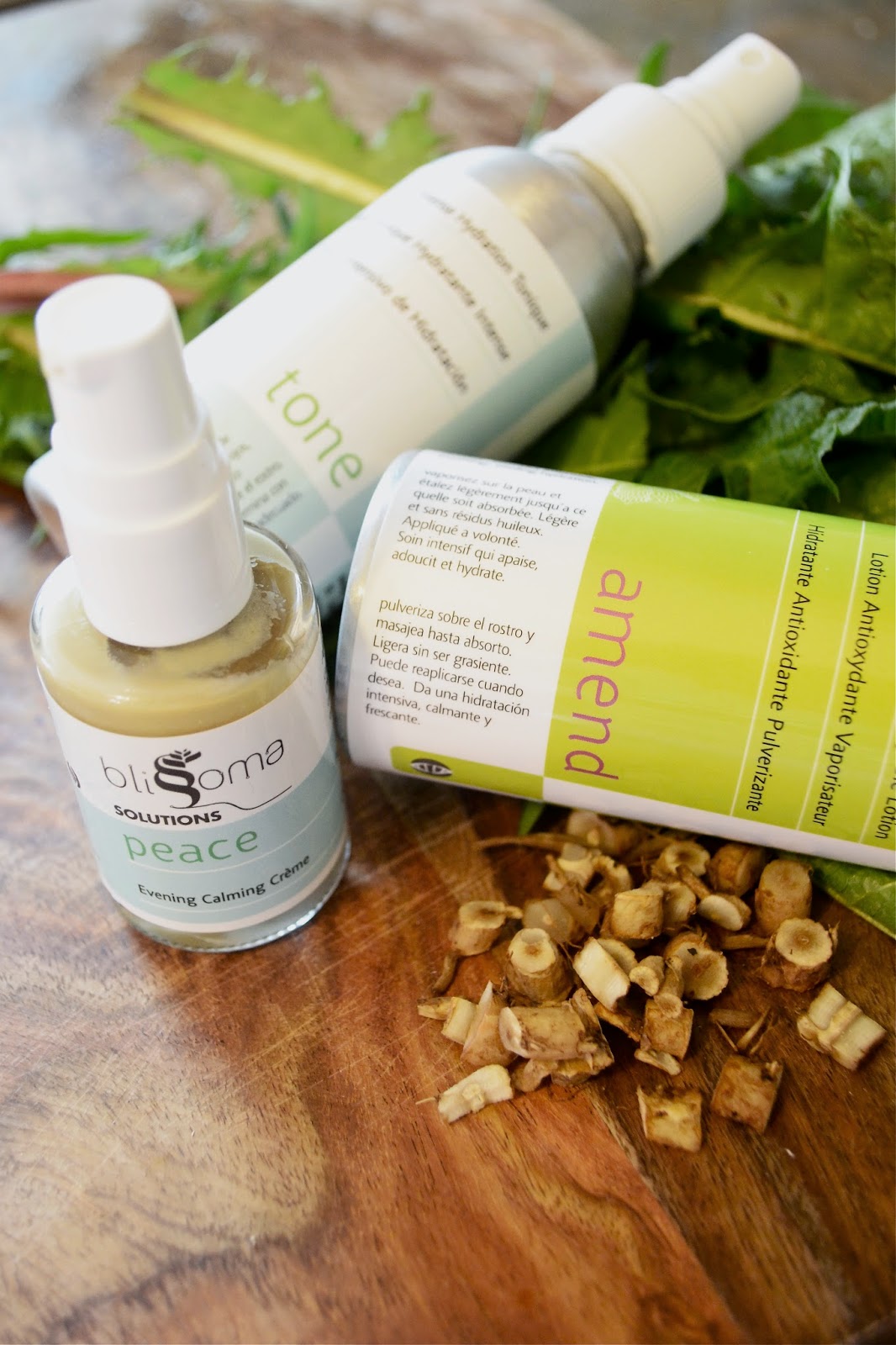
The inclusion of minerals is one reason our recipes like Peace Evening Facial Creme and Amend Antioxidant Lotion can be light and absorbent and yet so effective at helping the skin maintain good moisture levels.  It's not just about the oils.  This is also why we believe in products that contain water as well as oil. (Though we do love our oil serums!)  Some folks may complain that products containing water are a waste of your dollars.  The fact remains that minerals and many phytonutrients like the anti-inflammatory compounds and flavonoids in herbs like dandelions cannot be carried by oils.  Minerals especially are water soluble and must be delivered through good old H20.  So if you're using products with good quality, water-based herb extracts like our Tone Intense Hydration Tonique (which also includes dandelion and other soothing herbs) you're still getting all kinds of beneficial compounds - it's so much more than just water.

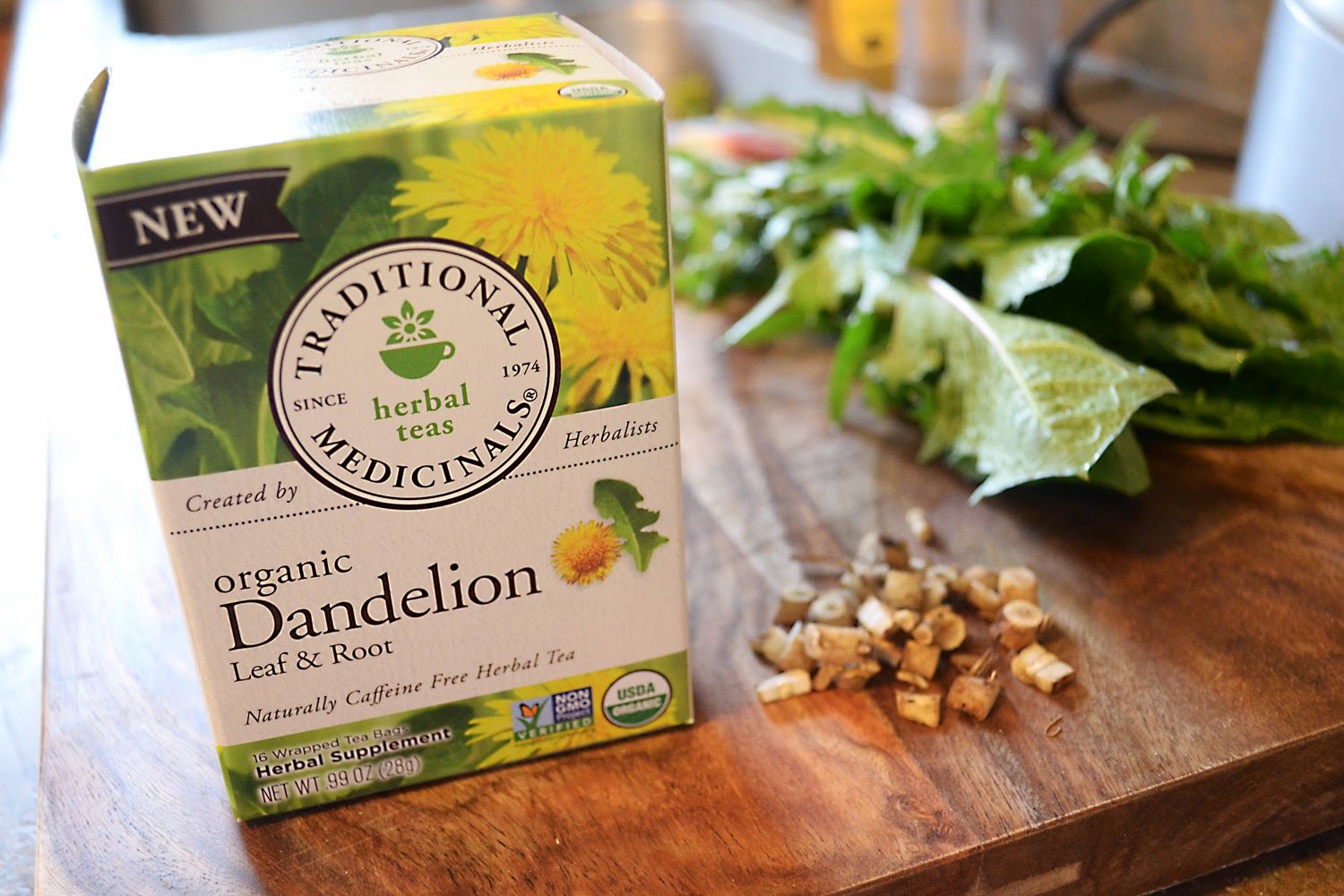
Traditional Medicinals Dandelion leaf and root tea.  Get the health benefits of dandelions from drinking a daily cup of dandelion tea.

If you can't gather wild dandelions then one great way to get them into your system is by drinking dandelion teas.  Traditional Medicinals makes several good dandelion teas that are delicious to sip and will help support your digestive health, hormonal balance, and beauty of your skin.  I highly recommend the raw, unroasted Dandelion Leaf and Root Tea for daily consumption.  It's mild and almost sweet and super easy to brew - just pop the tea bag in hot water, wait 10 to 15 minutes and drink your dandelions down.  

The organic Everyday Detox Dandelion Tea features dandelion leaf and root as well as fennel, peppermint, and licorice.  I personally love that anise-like flavor of the fennel and this blend is nicely done.  One benefit to supporting a product like these is that they are Certified Organic, which means no doubts about toxins if you don't have a field near you that you're sure isn't polluted with pesticides or other problems. 

To celebrate the fabulous qualities of dandelions I also made a video on how to gather and use them.  They're everywhere in the field that hosts Blissoma's community garden project and I'll never have to worry about having enough of my own - it's guaranteed abundance.


Smile when you see that little yellow "lion" flower emerging defiantly from your lawn.  Now you know all the good things it can do for you.

Dandelion root skincare by Blissoma to hydrate and balance skin.  Calming moisturizers for face and body.  Vegan natural skincare.
Note - Traditional Medicinals kindly provided me samples of their teas to evaluate.  I was not paid for my mention of them and all opinions are solely my own in the interest of helping people easily incorporate more healing plants into their routines.


Tuesday, May 13, 2014 in , , , , , , ,

10 Ways to Avoid Skin Damage by Choosing Natural Products - a natural beauty article for YoungandRaw.com

Julie Longyear guest expert contributor to Young and Raw healthy wellness lifestyle website

I've been fortunate enough to be added as a contributor to Young and Raw, a raw food based diet and lifestyle site.  In my skincare article for them I highlight some of my journey with natural beauty and offer ways that you can begin your own transition.  Your skin will thank you as you detox from the synthetic compounds and hormone disruptors found in many conventional products.  The healing power of plants really can't be surpassed.

"Unfortunately what I didn’t know and many people still don’t know is that mass produced skincare is actually ruining their skin and compromising their health due to the contaminated, hormone altering, and untested ingredients it contains. You may have heard that as your largest organ your skin absorbs products that are put on it. While the percentage is debatable and depends on the substance this is indeed true.  This makes it that much more amazing and rather alarming that cosmetics ingredients are not tested for safety or regulated by the FDA. Furthermore the actual priority of many manufacturers has nothing to do with safety or efficacy and a lot more to do with marketability and profit margins, cute packaging, and shelf stability instead of healthy results for customers."

For the 3 ways synthetic skincare is harming your skin and 10 of the best tips for shopping for clean, beneficial skincare see the article on Young and Raw.


Wednesday, January 8, 2014 in , , , , , , , ,

How antibacterial soap hurts my child's skin and more on safe skincare

That's my baby. Not today, but on a day many years ago when she had her first bath.  Just like then she still trusts me to make safe decisions to help her care for her body.  That mission has become ever more important to me the more I know about the hidden hazards of many of the personal care products in average stores and bathroom cabinets all across our country.  While I usually prefer to focus on the positive health benefits of natural choices every once in a while we have to talk about some of the scary details you need to know to stay safe.

Winter is the season of dry hands, and not just for adults.  Every winter Tru's hands get irritated by all the synthetic, triclosan-laden soaps that permeate public restrooms at stores and schools.  As a mom and as an advocate for healthy, toxin-free skincare this makes me upset and with plenty of reason. 

When she was in kindergarten the soaps at school made the backs of her hands lobster colored.  They stung, throbbed, and hurt her so badly she cried herself to sleep some nights, whimpering and avoiding touching anything.  I approached the school about changing soaps but they told me no-go, that the antibacterial soap was necessary. They said they could get sued for using just plain soap if a kid got the flu.  This gave me a supreme sense of irony that my daughter's burning skin was not enough of a concern to also cause worry or concern that a parent might take action.  Despite the fact that triclosan soaps are not proven to remove any more bacteria from hands than just plain soap and water businesses cling to them because they fear lawsuits and their suppliers continue to make and sell them.  The risk, work, and cost of switching looks higher than the perceived benefit.

On that particular occasion years ago I didn't even begin to get into the issue of toxin load and chemical buildup in our systems.  If her red hands were not enough evidence of a problem with the product then getting into more abstract concepts like toxin buildup was going to get nowhere at that point in time.  We resorted to sending her to school with her own handmade, organic bar of soap and the problem went away.  Healthy product = healthy skin.    If you are facing a similar circumstance and want to help your child avoid extra chemical exposure a personalized travel soap box and an organic bar of soap are easy to send along.

Yesterday once again Tru was relating to me that her hands had been getting dry like usual at this time of year.  She told me that the Neutrogena lotion she had used at another household had "really burned her skin" but that the grapeseed oil she got to use afterward made them feel better very quickly.  Again this provided really clear evidence of just how irritating many synthetic products are, especially to children.  Dry skin is even more sensitive too, as the dehydration of the horny layer puts nerves closer to the surface than usual.  That makes a reaction even more likely.

The FDA is currently reviewing triclosan closely and considering it's future in consumer products.  The FDA is rather lax about ingredients in personal care products so just that they are willing to publish a position that science is supporting a lack of benefit and a concern for human safety is a big step.

In the last few weeks I have been reading "Not Just a Pretty Face".  While I was aware of all the toxin risks discussed in the book it has definitely reinvigorated my passion for toxin-free products.  One of the prime takeaways is that children are one of the most at-risk groups for exposure to hormone disruptors like pthalates and parabens, both commonly found in antibacterial soaps along with triclosan.  Their developing systems process chemical loads differently than grown adults and it can cause more insidious problems than just a little skin irritation - problems like early sexual development, fertility problems later in life, and cancer.  Our endocrine (hormone) systems are very delicate and a little shove one way or another can create vastly different development of the body and abnormal cell growth.  All that handwashing we encourage our young children to do today might lead to problems down the road if we don't wash with something actually clean.

At home my family is very clean about the products we use.  We can make a big dent in Tru's chemical exposure by keeping at least one environment as natural and toxin-free as possible.  She may only be 9 (+3/4!) but she is excited about washing her face with mom's cleanser and moisturizer, and always happy to use our organic soap for her hands.  Thankfully I can have the utmost confidence that since those are literally made by me they are super pure!  But we still need these ideas spread to the rest of society and especially environments like schools where our children spend a lot of time.  Every person I speak with and try to share information about our toxin load problems as a society I know I'm saving someone else from irritation and disease.  Yes, it's my job to educate but I chose this line of work because of an interest in health.  While most of my clients are adults it is impossible to ignore that our children need clean care as well.  A need for natural skin and bodycare doesn't start at age 25 with a bad acne breakout or new allergies.  It begins before conception and continues throughout life.   

This one's for my baby and all the other mama's babies out there.  That includes you 30, 40, and 50 year olds.  You're somebody's baby too, so let's take care. How about if you eliminate antibacterial, perfumed soaps from your household this year in the interest of your safety and the safety of your family?  I challenge you to replace them all.  Just plain natural soap and water will keep you clean enough.


Thursday, August 1, 2013 in , , , , , , , , , , ,

5 Skin Benefits of Eating Salad


Salad has often gotten a bad reputation.  It is associated with the dieting girlfriend who won't order anything else, the long suffering vegetarian who can't find anything else to eat on a meat-heavy menu, and being used as a precursor to the "real" food in most meals.  Many men wouldn't be caught ordering only a salad when eating out or even eating in.  But all these salad stereotypes fail to celebrate the magnificence that salad is for your body and your health.  What's more a properly structured salad can be the real nutritional powerhouse of a meal, offering a multitude of benefits to your good looks many cooked foods can't claim.

Salads can be artful, flavorful, filling, and insanely nutritious when composed well.  If your only familiarity with salad is iceberg lettuce slathered in a bit of ranch dressing then it's time to up your game with some more creative salad recipes.

Salad is awesome for everything about your health but in terms of a beauty investment this one offers a motherload of benefits for such an easy dietary addition.  Let's investigate the awesomeness hiding in your crisper.

5 Skin Benefits of Eating Salad


1. Salad can increase your hydration level.

Most veggies are majority water, so when you eat them you naturally hydrate your body.  Despite the fact that we know we're supposed to drink a lot of water many people still don't get enough, making consumption of moisture-rich foods a way to add hydration to your system.  When your body is dehydrated so is your skin.  Dehydrated skin can have an increase in roughness, sensitivity, flaking, and fine lines or even cracking.  Both for appearances and comfort and dealing with summer's warm temperatures hydration is required, making fruits and veggies a great way to send your skin the liquid it longs for to perform and look its best.


2. Raw foods in salads mean no loss of vitamins and minerals due to cooking.

When you're eating uncooked foods you're giving your body a shot at the maximum vitamins and nutrients available in many foods.  It's a rare food that remains unchanged by cooking - only certain very stable nutrients don't degrade or migrate out of foods when they're heated.  The actual percentage of raw foods you should consume remains something many experts debate.  Overall though it's safe to say that eating some is one of the best ways to make sure every bite is adding a lot of nutrients to your system.  Raw foods also contain live enzymes that can assist with digestion, something cooked foods don't boast since enzymes are destroyed by heat.


3. Fiber in vegetables and fruits used for salads cleans the intestines and colon, making nutrient absorption more efficient. 

If your intestines are gummed up with gooey, fiber-free, processed foods they aren't going to be properly absorbing nutrition.  Almost every ingredient in a salad contributes fiber that sweeps through the digestive system, carrying leftover gunk with it and leaving intestinal and colon walls free to absorb all the virtuous vitamins you're eating every day.  What good is a nutrient if it never really gets into you?  Not much.  
We're all supposed to get approximately 25 grams of fiber in our diets per day.  Sadly most Americans fall far, far short.  There is a fiber supplement commercial that drives me nuts - they show a woman desperately eating an apple and a bran muffin while trying to exercise and work.  Honestly, it's not that hard to get your fiber when you actually eat fruits and vegetables.  Are we that far gone that we truly think eating an apple is a grueling effort?  Apples are awesome!
2 cups of lettuce equals .9 to 2 grams of fiber depending on the variety with delicate green leaf lettuce ranking lower and the stiff, crunchy Romaine ranking at the 2 gram mark.  Personally when I make a salad for a meal I use at least 4 cups of greens.  If you're making a slaw or salad mixed with cabbage you're adding even more fiber.  2 cups of shredded cabbage adds up to 3.6 grams of fiber.
Other salad additions like carrots, peppers, celery, tomatoes, beets, asparagus, mushrooms, and green peas can really bulk up your fiber intake and also make your salads more interesting.  For a helpful list of fiber in common portion sizes of different vegetables, fruits, and grains check out this PDF.


4. Use of quality oils in salad dressings can improve absorption of nutrients and provide moisturizing, anti-inflammatory omega fatty acids that benefit skin.

This point requires some specificity.  Dressings acquired from most average grocery stores are not going to qualify for this healthy advantage.  That's because they are made with refined canola and soy oils that may be partly rancid, contain pesticide residue, and have no vitamins of their own.  Mass market dressings also commonly contain artificial colors, high fructose corn syrup, and other ickies.  Either make a visit to your local health food store or order up some individual ingredients and make your own unique and healthful dressing instead.
Salad offers the opportunity for culinary use of oils not generally suited for cooking like hemp seed oil, walnut oil, and pumpkin seed oil.  The oils most packed with polyunsaturated fatty acids (Omega fatty acids) are the ones you can't heat because heat makes them oxidize, so cold applications are the best way to get their anti-inflammatory health benefits and delicious flavor.  Organic sunflower and olive oils are fine general purpose choices as well if you don't have specialty oils on hand.
Oils will increase your absorption of beta-Carotene and Vitamin K which are fat soluble.  As much as I enjoy a good smoothie unless folks are remembering to mix in a healthy oil they may not absorb the fat soluble vitamins as well.  This is where salad shines, since dressings usually always use some oil.  A bit of healthy oil can also improve your feeling of satisfaction and how long your energy from the meal will last, since fats take a while to break down into caloric energy.  The veggies will digest first and the fat will fuel you later.
Omega fatty acid rich oils provide balancing, anti-inflammatory effects for skin with positive results for dry skin and acne specifically.  Ironically consuming more Omega 3 fatty acids in healthy oils can make you break out less.

5. Nutrients in salad help synthesize collagen, provide natural sun protective effects, protect against wrinkling and sagging of skin, can improve dark under eye circles, and make skin smoother.  

Let's talk about some of the individual nutrients you get when eating exciting and varied salads.  There's a lot, and their benefits are well substantiated by peer reviewed science!


Carotenoids: 

Carotenoids are a class of compound that includes Vitamin A and all its varied forms.  Carotenoids have antioxidant and anti-inflammatory effects within the body.  Carrots, spinach, tomatoes, romaine lettuce are great sources of carotenoids.  Dark leafy greens are one of the richest sources, so if you're the type that enjoys a massaged kale salad, more power to you.

Carotenoids include beta-Carotene, lycopene, and other compounds like lutein and zeaxanthin.  Many plants that contain one contain numerous of these and a lot of the studies available substantiate the positive effects of the range of carotenoids.

Beta-Carotene:

Beta-Carotene is a form of Vitamin A found in plants and one we think of when we think of orange, yellow and red fruits and veggies.  It is a photoprotective agent and is thought to quench photochemical reactions in the epidermis involving oxygen radicals generated by UV exposure.  While most studies have not found a significant reduction in erythema (sunburn) there was better, more efficient immune system function in relation to sun exposure in individuals supplemented with Beta Carotene in studies.

Here's the bigger benefit for your skin... beta-Carotene was found to inhibit the action of matrix metalloproteinase (MMP)-9, a collagenase enzyme that breaks down the extracellular matrix and collagen, contributing to wrinkling and sagging.  In studies with mice fed dietary beta-Carotene the expression of MMP-9 was suppressed, along with corresponding wrinkles and sagging of skin.  That means you can literally eat your way to firmer, less wrinkled skin when including beta-Carotene rich foods in your diet.


Lycopene:

A significant correlation was obtained between the skin roughness and the lycopene concentration in tissues.  Lycopene levels being high meant smoother skin, lower levels meant rougher skin regardless of the age of the study participant.  Sun dried tomatoes are the food highest in lycopene with sweet red peppers also ranking well, so the extra money you shell out for the ripened peppers may serve your skin extra benefits.  Guavas, watermelon, and pink grapefruit all rank well, so feel free to add fruit to your concoctions.


Sulfur:

Sulfur is known as the "beauty mineral" and is concentrated in skin, nails, and hair.  It must be present for synthesis of collagen.  Get your daily dose of sulfur from onions and broccoli, red sweet pepper and parsely for your salads.  Slice onions thinly, as oxygen exposure allows more sulfur bearing compounds to form.  Raw produce is higher in sulfur than cooked, making salads an ideal way to get your dietary sulfur.


Vitamin K: 

This nutrient pops up in some topical under eye products, but is an under-recognized vitamin in foods.  It strengthens and keeps blood vessels flexible by inhibiting calcium deposits.  It can reduce bruising which is great for people who have eye circles caused by leaky, fragile blood vessels.  It is fat soluble and absorbs when accompanied by some fat.  You can get your Vitamin K in romaine lettuce, broccoli, cabbage, asparagus, and alfalfa sprouts.
(You might want to avoid alfalfa sprouts if you have lupus due to potential complications)


Vitamins C and E:

Dietary consumption of BOTH Vitamins C and E (together, not alone) can show sun protective effects for your skin in as little as 8 days.  4 separate studies have substantiated this effect, albeit at different amounts of vitamin supplementation and different lengths of days taken to establish photoprotective effects.  Participants showed increased resistance to UVB-induced sunburn and protection from DNA damage.   This means by including foods rich in both these vitamins in your diet you are providing yourself the equivalent of internal sunscreen!  Red peppers, citrus fruits, and papaya are tasty sources of Vitamin C, and you can get your Vitamin E through tasty toppings of sunflower seeds, almonds, and other nuts.


Flavonoids:

Flavonoids are fabulous phytochemicals that occur in plants.  You won't find them in meats, so bulk up on the botanicals to get your servings.  A case-control study in an Italian population found a negative correlation between skin cancer and consumption of flavonoid rich foods and beverages like tea.  Best results were obtained with high consumption of vegetables, particularly carrots, cruciferous and leafy vegetables, and fruits, especially citrus.  

So are you convinced to break out your salad spinner with me?  I'm thinking the case for how salad can boost your beauty is compelling, and fully plan to treat my salads as reverently as my serums.  Together they'll go farther!

For some drool-worthy recipes that will have you wondering why you stuck to plain lettuce for so long check out the Salad Recipe page at Young and Raw, and KrisCarr.com where numerous bloggers post their creative contributions.

You can also try my own recipe for Strawberry and Pickled Beet Salad with Raspberry Balsamic Vinaigrette, which comes not a moment too soon - all this writing has made me hungry!


Monday, July 1, 2013 in , , , , ,

The Importance of PH for Skin (and flashbacks to Jr. High chemistry class)


PH is one of those things that many folks may remember from basic chemistry class in Junior High or High School.  It's also one of the things the skincare industry loves to bandy about as a reason to use a toner or to sell you a product that claims to be "PH balanced".  Like many other terms in the skincare industry there is no actual standard for what the phrase "PH balanced" means.  For shoppers that means your best plan is to get a better understanding of this issue so you can avoid discomfort or just being convinced to purchase products that are not ideal for your skin.

From youthful days in middle school you may remember pipettes and putting liquid drop by drop into a beaker to watch for a color shift, telling you the PH had changed.  This is, of course, assuming that you weren't too busy staring at your cute lab partner or daydreaming about pizza, new shoes, or your latest drama with friends (and there was plenty of that).  The very important issues vying for our brain space may have caused some of the chemistry to float out as soon as it was unused.  Not everyone revisited that knowledge in later classes so for the sake of all we'll go over the basics.

PH is a measure of the free H+ or OH- ions running around in solution sending off electronic charges.  You might recall that neutral PH is a 7 on the scale and anything below 7 to 0 is acidic and has H+ (Hydrogen) ions.  Above 7 to 14 is basic or alkaline and has OH- (Hydroxide) ions.  This knowledge is also handy for keeping fish alive in aquariums and growing plants, as water and soil PH can have drastic effects on living things attempting to make a home in either environment.


Your skin has a natural PH of about 4.7 to just under 5.  That is an acidic PH.  Your skin is made up of protein which in turn is made up of amino acids.  There is also a protective acid mantle on the skin that provides you natural defense against your environment.  That means there's at least some happy H+ ions hanging out on your skin.

According to scientific evidence it is beneficial for the good bacteria and flora on your skin as well as keeping skin moisturized to maintain a PH below 5 as much as possible.
 
"Not only prior use of cosmetic products, especially soaps, have profound influence on skin surface pH, but the use of plain tap water, in Europe with a pH value generally around 8.0, will increase skin pH up to 6 h after application before returning to its 'natural' value of on average below 5.0. It is demonstrated that skin with pH values below 5.0 is in a better condition than skin with pH values above 5.0, as shown by measuring the biophysical parameters of barrier function, moisturization and scaling."   Lambers H, Piessens S, Bloem A, Pronk H, Finkel P, 2006


This same evidence shows that your natural defenses are decreased when your skin PH is raised too high.  Another study, The Importance of Skin PH by Gil Yosipovitch, MD and Judy Hu, MD from 2003, found that it can take up to 14 hours for skin to return to normal PH after washing with a soap cleanser.  Skin conditions like eczema, dermatitis, and dry skin can also cause unwanted increases in skin PH all by themselves, which soap only aggravates further.

While your acid mantle is eroded your defenses are down.  That leaves you more vulnerable to acne bacteria, moisture loss, and irritation.

While Blissoma does make 2 soap bars that are designed to be mild enough for facial use the fact remains that anyone with an irritated skin condition or who is prone to acne should use a low PH, non soap cleanser.  I generally recommend our soaps to younger individuals or just to people who have resilient skin.  If you are not prone to irritations, dryness, acne, dermatitis, or eczema then you should be able to use a bar soap without trouble.

However, if you do have skin that is prone to any of these irritated conditions you should use our Fresh Mild Rice Cleanser or Free Rejuvenating Herbal Gel Cleanser for best results.  These cleansers are both acidic PH of about 4.5, perfect to keep your skin at the acid PH it loves.

All of Blissoma's moisturizers are made with a skin-friendly acidic PH as well to work with your acid mantle and replenish hydration.

Cleansing with soap based cleansers is one of the primary things unfortunately going wrong in the natural skincare world.  While natural liquid soaps can be wonderful products for cleaning your home and even your hands they are not ideal for your face.  You may be surprised what a simple switch to a PH correct cleanser can do to heal your skin.  Acne can be reduced just by this simple switch.

So what about that toner the lady at the department store counter is trying to sell you to "correct" the PH of your skin after toning?  Can a toner do that?  Well, sortof.  Applying an acidic product will help urge your skin back towards a happier, acidic PH if you've just used a basic cleanser or if you are located in an area with high PH water.  Quite frankly, though, nothing can replace your actual acid mantle except your own skin working hard to restore itself.  It's ideal to avoid disturbing it at all when you have irritable skin.


If you are going to use a soap is there a reason to choose a bar soap over a liquid soap?  Yes, there is.  Natural bar soaps are more superfatted than liquid soaps, which means they have extra oil in them that was not made into soap by the lye reaction.  This extra oil helps deposit nourishment as the bar cleanses.  Blissoma's facial soaps also contain portions called "unsaponifiables" which are fatty portions of the oils that cannot be made into soap and come from solid oils like Shea Butter.  These are calming and emollient for skin.  Unsaponifiables cannot be used in liquid soaps as they would still be solid or would cause cloudiness.  This is one way bar soaps are superior for moisturizing skin versus a liquid natural soap.

Cleansing in particular is one of the steps of skincare routines that is frequently done improperly.  People think washing their skin is no big deal.  Many people think moisturizer must be much more important since it is on for longer.  Unfortunately this is just not true.  If you are cleansing your skin in a way that is incompatible with your PH balance needs you are upsetting your skin for the whole day to come.  Your moisturizer cannot fix that.  


Your overall skin comfort and  health will be dramatically improved if you cleanse in a way your skin can tolerate.  For many people this means transitioning off of soap and onto acidic PH cleansers.  This is especially true for your face, which is much more delicate skin than much of the rest of your body.  You may still be able to get away with using a good quality natural soap to cleanse your body but receive dramatic benefits when you use a non-soap cleanser on your face.

Oil Cleansing Method would qualify as a routine that doesn't damage your acid mantle.  It uses clean oil to lift dirty oil from your skin, and since oil is made up of fatty acids that acid aspect makes it really friendly. It's not ideal for everyone though, so the good news is that most gel and cream cleansers also fall into the non-soap cleanser category.  Some people even debate the worthiness of cleansing with water at all - which in some ways is understandable if your water PH is an 8 as that would indeed be irritating.  I'm a big fan of cleansing though as a good bit of gunk can build up on your face day in and day out.  I just like to do it with a product that is soothing, not stressing, and I'm personally a twice a day girl to maintain my skin's brightness and comfort.

I hope this information helps you transition to a happy PH for your skin.  Let me know if you try switching to a skin-friendly non-soap cleanser and the difference it makes for you.
 

Copyright 2011 Blissoma and Julie Longyear. Powered by Blogger.