
flavor

Showing posts with label flavor. Show all posts. The posts are listed in chronological order. Click the post title to read more.

Thursday, August 1, 2013 in , , , , , , , , , , , , ,

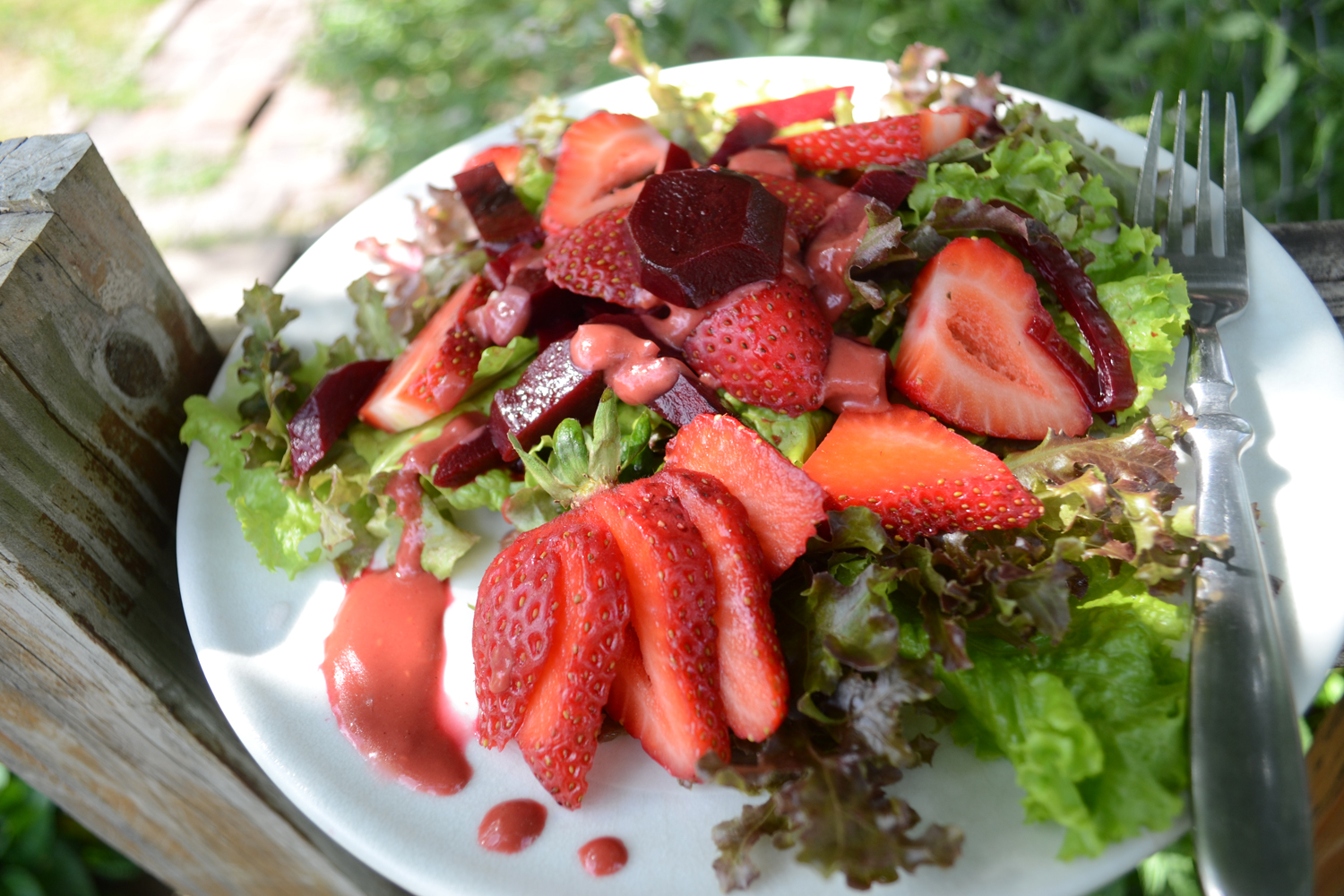
Strawberry and Pickled Beet Salad with Raspberry Balsamic Dressing

Strawberry and pickled beet salad recipe

There's little better way to celebrate the bounty of early summer or to nourish your body than with a bright and beautiful salad.  Enter the Strawberry and Pickled Beet Salad....

As covered in my post 5 Skin Benefits of Eating Salad there's a host of happy results when you fit some fresh fruits and veggies on your plate en masse at least once a day.  Read up and then come on back to make this sweet and unexpected dish.

Since we've already covered the health benefits of salad and beets in particular in other posts we'll get right to the recipe. All the fresh ingredients used are in season in summer meaning you can eat totally locavore for this dish. My spring beets were ready to pick in June, as were the berries and the last of the lettuce.


Strawberry and Pickled Beet Salad with Raspberry Balsamic Dressing

Raspberry Balsamic Vinaigrette Dressing

1 cup fresh or frozen raspberries
½ cup grapeseed oil
¼ cup olive oil
3 TBSP raspberry balsamic vinegar
1 TBSP real maple syrup
1/16 tsp cloves
1/16 tsp allspice
pinch of salt
1 TBSP minced shallot

Puree raspberries in blender or food processor.  Blend in remaining ingredients except for shallot.  Stir minced shallot in by hand.  Stir dressing before adding to salad.

I used di Olivas Raspberry Balsamic Vinegar, which is a very syrupy, thick, sweet vinegar you can practically drink straight.  It is a gourmet vinegar only available at their own store here in St. Louis.  If you can't get a raspberry balsamic in your area then go for the best quality plain balsamic you can get.   The quality of the vinegar will greatly affect the final result of your dressing.


Salad Recipe (per plate or bowlful)

3 cups organic spring mix, red or green oakleaf or other quality lettuce, washed and spun dry
1/2 cup homemade pickled beets (see my recipe)
1 cup sliced strawberries
2 tsp chia seeds (optional)
Raspberry Balsamic Vinaigrette dressing, quantity as desired

Arrange sliced, pickled beets and sliced strawberries evenly over the lettuce.  Sprinkle chia seeds and drizzle dressing on to taste.  Eat and enjoy!


I served this original salad at the 6/21 Dinner in the Garden held in the Blissoma Community Garden and hosted by myself and Jessica Leitch of City in a Jar.  The event was inspired by Jessica Murnane of One Part Plant who has been exciting me with her For Reals Meals series that features collaborations with creative professionals in Chicago, slow food recipes, and general awesomeness.  I'll be posting more of the recipes created just for our Dinner in the Garden/St. Louis For Reals Meals event soon and you can catch the full photo story on both City in a Jar and From the Bathtub.
 

in , , , , , , , , , , ,

5 Skin Benefits of Eating Salad


Salad has often gotten a bad reputation.  It is associated with the dieting girlfriend who won't order anything else, the long suffering vegetarian who can't find anything else to eat on a meat-heavy menu, and being used as a precursor to the "real" food in most meals.  Many men wouldn't be caught ordering only a salad when eating out or even eating in.  But all these salad stereotypes fail to celebrate the magnificence that salad is for your body and your health.  What's more a properly structured salad can be the real nutritional powerhouse of a meal, offering a multitude of benefits to your good looks many cooked foods can't claim.

Salads can be artful, flavorful, filling, and insanely nutritious when composed well.  If your only familiarity with salad is iceberg lettuce slathered in a bit of ranch dressing then it's time to up your game with some more creative salad recipes.

Salad is awesome for everything about your health but in terms of a beauty investment this one offers a motherload of benefits for such an easy dietary addition.  Let's investigate the awesomeness hiding in your crisper.

5 Skin Benefits of Eating Salad


1. Salad can increase your hydration level.

Most veggies are majority water, so when you eat them you naturally hydrate your body.  Despite the fact that we know we're supposed to drink a lot of water many people still don't get enough, making consumption of moisture-rich foods a way to add hydration to your system.  When your body is dehydrated so is your skin.  Dehydrated skin can have an increase in roughness, sensitivity, flaking, and fine lines or even cracking.  Both for appearances and comfort and dealing with summer's warm temperatures hydration is required, making fruits and veggies a great way to send your skin the liquid it longs for to perform and look its best.


2. Raw foods in salads mean no loss of vitamins and minerals due to cooking.

When you're eating uncooked foods you're giving your body a shot at the maximum vitamins and nutrients available in many foods.  It's a rare food that remains unchanged by cooking - only certain very stable nutrients don't degrade or migrate out of foods when they're heated.  The actual percentage of raw foods you should consume remains something many experts debate.  Overall though it's safe to say that eating some is one of the best ways to make sure every bite is adding a lot of nutrients to your system.  Raw foods also contain live enzymes that can assist with digestion, something cooked foods don't boast since enzymes are destroyed by heat.


3. Fiber in vegetables and fruits used for salads cleans the intestines and colon, making nutrient absorption more efficient. 

If your intestines are gummed up with gooey, fiber-free, processed foods they aren't going to be properly absorbing nutrition.  Almost every ingredient in a salad contributes fiber that sweeps through the digestive system, carrying leftover gunk with it and leaving intestinal and colon walls free to absorb all the virtuous vitamins you're eating every day.  What good is a nutrient if it never really gets into you?  Not much.  
We're all supposed to get approximately 25 grams of fiber in our diets per day.  Sadly most Americans fall far, far short.  There is a fiber supplement commercial that drives me nuts - they show a woman desperately eating an apple and a bran muffin while trying to exercise and work.  Honestly, it's not that hard to get your fiber when you actually eat fruits and vegetables.  Are we that far gone that we truly think eating an apple is a grueling effort?  Apples are awesome!
2 cups of lettuce equals .9 to 2 grams of fiber depending on the variety with delicate green leaf lettuce ranking lower and the stiff, crunchy Romaine ranking at the 2 gram mark.  Personally when I make a salad for a meal I use at least 4 cups of greens.  If you're making a slaw or salad mixed with cabbage you're adding even more fiber.  2 cups of shredded cabbage adds up to 3.6 grams of fiber.
Other salad additions like carrots, peppers, celery, tomatoes, beets, asparagus, mushrooms, and green peas can really bulk up your fiber intake and also make your salads more interesting.  For a helpful list of fiber in common portion sizes of different vegetables, fruits, and grains check out this PDF.


4. Use of quality oils in salad dressings can improve absorption of nutrients and provide moisturizing, anti-inflammatory omega fatty acids that benefit skin.

This point requires some specificity.  Dressings acquired from most average grocery stores are not going to qualify for this healthy advantage.  That's because they are made with refined canola and soy oils that may be partly rancid, contain pesticide residue, and have no vitamins of their own.  Mass market dressings also commonly contain artificial colors, high fructose corn syrup, and other ickies.  Either make a visit to your local health food store or order up some individual ingredients and make your own unique and healthful dressing instead.
Salad offers the opportunity for culinary use of oils not generally suited for cooking like hemp seed oil, walnut oil, and pumpkin seed oil.  The oils most packed with polyunsaturated fatty acids (Omega fatty acids) are the ones you can't heat because heat makes them oxidize, so cold applications are the best way to get their anti-inflammatory health benefits and delicious flavor.  Organic sunflower and olive oils are fine general purpose choices as well if you don't have specialty oils on hand.
Oils will increase your absorption of beta-Carotene and Vitamin K which are fat soluble.  As much as I enjoy a good smoothie unless folks are remembering to mix in a healthy oil they may not absorb the fat soluble vitamins as well.  This is where salad shines, since dressings usually always use some oil.  A bit of healthy oil can also improve your feeling of satisfaction and how long your energy from the meal will last, since fats take a while to break down into caloric energy.  The veggies will digest first and the fat will fuel you later.
Omega fatty acid rich oils provide balancing, anti-inflammatory effects for skin with positive results for dry skin and acne specifically.  Ironically consuming more Omega 3 fatty acids in healthy oils can make you break out less.

5. Nutrients in salad help synthesize collagen, provide natural sun protective effects, protect against wrinkling and sagging of skin, can improve dark under eye circles, and make skin smoother.  

Let's talk about some of the individual nutrients you get when eating exciting and varied salads.  There's a lot, and their benefits are well substantiated by peer reviewed science!


Carotenoids: 

Carotenoids are a class of compound that includes Vitamin A and all its varied forms.  Carotenoids have antioxidant and anti-inflammatory effects within the body.  Carrots, spinach, tomatoes, romaine lettuce are great sources of carotenoids.  Dark leafy greens are one of the richest sources, so if you're the type that enjoys a massaged kale salad, more power to you.

Carotenoids include beta-Carotene, lycopene, and other compounds like lutein and zeaxanthin.  Many plants that contain one contain numerous of these and a lot of the studies available substantiate the positive effects of the range of carotenoids.

Beta-Carotene:

Beta-Carotene is a form of Vitamin A found in plants and one we think of when we think of orange, yellow and red fruits and veggies.  It is a photoprotective agent and is thought to quench photochemical reactions in the epidermis involving oxygen radicals generated by UV exposure.  While most studies have not found a significant reduction in erythema (sunburn) there was better, more efficient immune system function in relation to sun exposure in individuals supplemented with Beta Carotene in studies.

Here's the bigger benefit for your skin... beta-Carotene was found to inhibit the action of matrix metalloproteinase (MMP)-9, a collagenase enzyme that breaks down the extracellular matrix and collagen, contributing to wrinkling and sagging.  In studies with mice fed dietary beta-Carotene the expression of MMP-9 was suppressed, along with corresponding wrinkles and sagging of skin.  That means you can literally eat your way to firmer, less wrinkled skin when including beta-Carotene rich foods in your diet.


Lycopene:

A significant correlation was obtained between the skin roughness and the lycopene concentration in tissues.  Lycopene levels being high meant smoother skin, lower levels meant rougher skin regardless of the age of the study participant.  Sun dried tomatoes are the food highest in lycopene with sweet red peppers also ranking well, so the extra money you shell out for the ripened peppers may serve your skin extra benefits.  Guavas, watermelon, and pink grapefruit all rank well, so feel free to add fruit to your concoctions.


Sulfur:

Sulfur is known as the "beauty mineral" and is concentrated in skin, nails, and hair.  It must be present for synthesis of collagen.  Get your daily dose of sulfur from onions and broccoli, red sweet pepper and parsely for your salads.  Slice onions thinly, as oxygen exposure allows more sulfur bearing compounds to form.  Raw produce is higher in sulfur than cooked, making salads an ideal way to get your dietary sulfur.


Vitamin K: 

This nutrient pops up in some topical under eye products, but is an under-recognized vitamin in foods.  It strengthens and keeps blood vessels flexible by inhibiting calcium deposits.  It can reduce bruising which is great for people who have eye circles caused by leaky, fragile blood vessels.  It is fat soluble and absorbs when accompanied by some fat.  You can get your Vitamin K in romaine lettuce, broccoli, cabbage, asparagus, and alfalfa sprouts.
(You might want to avoid alfalfa sprouts if you have lupus due to potential complications)


Vitamins C and E:

Dietary consumption of BOTH Vitamins C and E (together, not alone) can show sun protective effects for your skin in as little as 8 days.  4 separate studies have substantiated this effect, albeit at different amounts of vitamin supplementation and different lengths of days taken to establish photoprotective effects.  Participants showed increased resistance to UVB-induced sunburn and protection from DNA damage.   This means by including foods rich in both these vitamins in your diet you are providing yourself the equivalent of internal sunscreen!  Red peppers, citrus fruits, and papaya are tasty sources of Vitamin C, and you can get your Vitamin E through tasty toppings of sunflower seeds, almonds, and other nuts.


Flavonoids:

Flavonoids are fabulous phytochemicals that occur in plants.  You won't find them in meats, so bulk up on the botanicals to get your servings.  A case-control study in an Italian population found a negative correlation between skin cancer and consumption of flavonoid rich foods and beverages like tea.  Best results were obtained with high consumption of vegetables, particularly carrots, cruciferous and leafy vegetables, and fruits, especially citrus.  

So are you convinced to break out your salad spinner with me?  I'm thinking the case for how salad can boost your beauty is compelling, and fully plan to treat my salads as reverently as my serums.  Together they'll go farther!

For some drool-worthy recipes that will have you wondering why you stuck to plain lettuce for so long check out the Salad Recipe page at Young and Raw, and KrisCarr.com where numerous bloggers post their creative contributions.

You can also try my own recipe for Strawberry and Pickled Beet Salad with Raspberry Balsamic Vinaigrette, which comes not a moment too soon - all this writing has made me hungry!


Tuesday, March 12, 2013 in , , , , , , , , , , , , , , ,

Cooking with Essential Oils - A Complete Guide to the "Essence of Flavor"

Photo by Jonathan Gayman
Most people have never cooked with essential oils either due to lack of familiarity, lack of access, or the common repetition by many aromatherapy sources that say not to ingest them.  One secret of the food industry is that essential oils are used ubiquitously in packaged foods as a source of extra flavor.  Anyone consuming canned, frozen, or even boxed foods is almost assuredly already eating essential oils and a large list of essential oils is approved by the FDA for consumption as safe.  While they are potent, and best used with care my personal feeling is that people are missing out on an amazing sensory experience skipping these ingredients in their cooking.  

To help you venture into the world of essential oils for your home cooked meals I put together a complete guide to cooking with essential oils with the help of Feast Magazine St. Louis.  Armed with a little knowledge you can begin to have all kinds of exotic flights of flavor fancy.  The story below includes links to 6 recipes I created from scratch for the article to help you make 4 complete courses all devised for maximum aromatic impact.  Enjoy, and please let me know if you try them!

From Feast Magazine St. Louis, February 2013 
Essential oils are most commonly associated with candles, fragrances and beauty products. However, the volatile oils produced by plants, their roots and their fruits are the building blocks upon which we create flavor in cooking. We grind herbs in a mortar and pestle when making vinaigrettes to extract the rich oils. We zest lemons and limes for the concentrated flavor found in the oils of their skins. So why don’t most people cook with bottled essential oils? Many oils available on the market aren’t intended for consumption. But seek out those essences made for cooking and you’ll open your kitchen to a whole new world of flavor.

Cooking with essential oils is simply another way to season dishes, much like using spices and herbs. But they bring with them a number of benefits. Most notably, the concentration of flavor. Oftentimes just one drop of essential oil is enough to infuse an entire dish with flavor. No picking, peeling, chopping, grinding or grating necessary. The distiller has already done all the work for you by presenting the volatile oils in their straight form. And unlike with dried herbs or ground spices, shelf stability isn’t a concern. Essential oils are not vulnerable to bacteria and don’t go rancid like vegetable oils might. Some oils can change a bit over time or oxidize, but in general, essential oils keep for years.

If the oils are purchased from a reliable source, quality and freshness of flavor are unmatched. Essential oil suppliers grow specific varieties of plants and use the best growing conditions to maximize the aromas in the plants they harvest. The plants are sent straight to distillation to capture their true profile, and distillers are careful not to compromise the quality of their oils with heat or other factors. In addition, one can access varieties of plants and unusual flavors that are simply not available in other forms. Neroli, for example, is the bitter orange flower. It’s very famous in perfumery and is only available as an oil. Bitter orange flowers are not sold for use, and even if they were, the aroma is so delicate and transient that by the time the blossoms reached you it would have deteriorated.

So how do you begin working with these intense and intriguing oils? Start by substituting them for the herbs and spices in your favorite recipes, keeping the following guidelines in mind.
Essential oils are oil-based and will dilute well in alcohol, vinegars, oils and fats. These elements need to be present in the recipe you’re using. Foods that are naturally rich in fat, such as dark or rich meats, fatted dairy products and coconut milk, work well. Starchy vegetables, beans, lentils and grains can also distribute the oils well enough if they’re also blended with a little cooking oil. Stews and chunky, thick soups are a good place to start, and dips, pestos and creamy sauces are the perfect testing ground for working with essential oils.

Essential oils are quite potent. If following a recipe, you can use the ratio of 1 Tbsp dried herb = 3 Tbsp fresh herb = 1 drop essential oil. If you need to use less than one drop in a recipe, dip a toothpick in the oil and swirl it into the dish. Essential oils can also be diluted with food-grade oils. Create 50 percent, 25 percent or 10 percent dilutions for use in smaller batches of food. If you’re experimenting on your own, start slowly by adding one drop at a time. Taste the dish and adjust the seasoning based on your preference.

Essential oils will “flash off.” With extended heat, so using them in cold applications is a wonderful way to get the maximum benefit. Using a small amount in olive oils and vinegars as a final dressing to foods works well. If using them in soups and sauces, add them at the last possible step, when heat exposure is minimal. Baked goods obviously will be exposed to heat, so some loss may occur. Consider increasing the amount of essential oils used in baked items to ensure the final product will still have lots of flavor.

Tips are included in the link to Feast's website including a list of good oils to start with and ones to avoid to help guide you through cooking with essential oils.   Visit their site to see my list of recommended and favorite oils.

And, check out a collection of recipes linked below that feature a variety of essential oils in a number of applications.  Each recipe was devised by myself through my 10+ years of experimenting with oils in my herbal studio and home kitchen.  Flavor is really my strength and while I may not have all the skills of a gourmet chef I can season a sauce and achieve something that will really please a palate.  Several recipes are vegan and numerous are gluten-free for my followers that pursue alternative food lifestyles.


Photo by Jonathan Gayman
Triple Celery Soup (Vegetarian and Gluten-Free)
This delectably creamy soup offers a full, savory taste built on a bevy of veggies. Celery root, celery stalks and potato make a satisfying base, while white wine and apple lend a pleasant sweetness in the mouth. Celery leaf extract, parsley and the unusual touch of star anise create an aromatic treat that will have you taking your bowl back for seconds.

Coriander and Pink Pepper Flatbread (Vegan and Gluten-Free)
These crunchy flatbreads don't disappoint. Whole spelt flour creates a healthy base for a subtle but insistent blend of coriander and pink pepper. Horseradish loses its bite in the baking process but provides a full, mellow undertone.

Whiskey, Fenugreek and Fig Balsalmic Chicken Wings
Take wings in a sophisticated direction with a smoky, spicy marinade and syrupy molasses and balsamic reduction. The whole dish will have you smacking your lips and licking your fingers for the last drops of the delicately flavored sauce. Jicama sticks soak up the sweet stuff and offer a clean, satisfying crunch between bites of fragrant meat.
 
Cumin, Apricot, and Grapefruit Braised Winter Vegetables (Vegan and Gluten-Free)
This tasty vegetable dish is thoroughly infused with the bright flavors of apricot and grapefruit, which contrast nicely with earthy cumin essence and saffron. It's an unexpected combination but an irresistible one.
Photo by Jonathan Gayman

Raspberry, Rose, and Neroli Coconut Ice Cream (Vegan and Gluten-Free)
A dairy-free, rosy dessert that cleanses the palate and offers an inviting combination of fruit and precious flowers. Super-simple preparation but a big wow factor for flavor. Altogether a singularly intriguing and elegant dessert experience.


Rose, Ginger, and Assam Tea Cookies (Vegetarian)
These turbinado sugar-topped cookies offer a crunch that makes a delightful companion to ice cream. The decadent Ginger Aftelier Chef's Essence dominates on the tongue with a hint of rose otto flitting about in the background. This buttery, classy take on a shortbread makes fine friends at a luncheon or tea or as a snack or dessert.

Following is a list of essential oils used as food flavorings that are GRAS by the FDA.  See the original list including latin names on their site.

Alfalfa, Allspice, Almond - bitter (free from prussic acid), Ambrette seed, Angelica root, Angelica seed, Angelica stem, Angostura (cusparia bark), Anise, asafetida, Balsam of Peru, Basil, Bay leaves, Bay (myrcia oil), Bergamot (bergamot orange), Bois de Rose, Cacao, Chamomile flowers  (Hungarian, Roman, and English), Cananga, Capsicum, Caraway, Cardamom seed, Carob bean, Carrot, Cascarilla bark, Cassia bark (Chinese, Padang, Batavian, and Saigon), Celery seed, Cherry wild bark, Chervil, Chicory, Cinnamon bark (Ceylon, Chinese, Saigon), Cinnamon leaf (Ceylon, Chinese, Saigon), Citronella, Citrus peels, Clary Sage, Clover, Coca (decocainized), Coffee, Cola nut, Coriander, Cumin, Curacao Orange peel, Cusparia bark, Dandelion root, Dog grass (quackgrass triticum), Elder flowers, Estragole (esdragol, esdragon, tarragon), Estragon (tarragon), Fennel sweet, Fenugreek, Galanga, Geranium (East Indian and rose), Ginger, Grapefruit, Guava, Hickory bark, Horehound, Hops, Horsemint, Hyssop, Immortelle, Jasmine, Juniper berries, Kola nut, Laurel (berries and leaves), Lavender, Lavender spike, Lavandin, Lemon, Lemon Balm, Lemongrass, Lemon peel, Lime, Linden flowers, Locust bean, Lupulin, Mace, Mandarin, Marjoram sweet, Mate, Melissa (lemon balm), Menthol, Menthyl acetate, Molasses extract, Mustard, Naringin, Neroli bigarade, Nutmeg, Onion, Orange bitter (flowers and peel), Orange leaf,  Orange sweet (flowers and peel), Origanum, Palmarosa, Paprika, Parsley, Pepper (black and white), Peppermint, Peruvian Balsam, Petitgrain (lemon, mandarin, and tangerine), Pimenta, Pimenta leaf, Pipsissewa leaves, Pomegranate, Prickly ash bark, Rose absolute, Rose otto and attar of roses, Rose (buds, flowers, fruit/hips), Rose geranium, Rose leaves, Rosemary, Saffron, Sage (officinalis, Greek and Spanish), St. John's bread, Savory (summer and winter), Schinus molle, Sloe berries, Spearmint, Spike lavender, Tamarind, Tangerine, Tarragon, Tea, Thyme (white, wild or creeping), Triticum (dog grass), Tuberose, Turmeric, Vanilla, Violet (flowers and leaves), Violet leaves absolute, Wild Cherry bark, Ylang-ylang, Zedoary bark

Questions?  Comment and I'll be happy to reply with answers to guide you.

Article originally published in the February 2013 issue of Feast Magazine.  Story and recipes by Julie Longyear, dishes prepared by Angela Komis. 
 

Copyright 2011 Blissoma and Julie Longyear. Powered by Blogger.